

It is currently estimated that worldwide a woman is diagnosed with breast cancer every 3 minutes, and one dies of it every 14 minutes. On the other hand, breast cancer is the disease with practically the highest chance of cure if detected early.
In patients with breast cancer (both women and men can be affected), malignant cells grow uncontrollably in the breast tissue. The cells lining the ducts and lobules of the breast grow abnormally, and cancer inside the breast can spread to nearby tissues.
Risk factors and causes of breast cancer
- Genetics is the most common factor in the development of breast cancer. Unfortunately, women aged 50-60 and over are more prone to this type of cancer, but recent studies have shown that it is "getting younger" considerably, being diagnosed more and more often in young women.
- An unhealthy lifestyle – smoking, drinking alcohol, eating junk food – is also among the risk factors. Overweight people, especially after menopause, are most at risk.
- Late age at first childbirth.
- Long-term use of contraceptives
- Hormonal imbalances
- Radiation exposure


Symptoms of breast cancer
It is absolutely necessary to see an oncologist-mammologist if you have any of the following symptoms:
- Changes in the shape, consistency, size or appearance of the breasts and nipple
- A lump, usually painless, in the breast or armpit
- Bleeding or discharge from the nipple when it is squeezed
- Crusts on the nipple
Diagnosis and treatment methods for breast cancer
A multidisciplinary team is involved in diagnosing breast cancer: the internist, the mammologist, the surgical oncologist, the gynecologist and the endocrinologist.
An accurate diagnosis is made through examinations, often high-tech ones, including:
- laboratory tests
- breast ultrasound
- axillary lymph node biopsy
- mamografie
- bone scintigraphy
Mammography as a way of checking the breasts
Thanks to this procedure, breast diseases can be identified and treated at an early stage.
At the Sancos clinic we have the only Invenia ABUS device in the country – a modern X-ray-free system for thoroughly examining the breasts. A scan with the Invenia ABUS system takes just one minute per breast, and a single procedure identifies all cancerous tumors, if present. The scan is done in 3D, and the data obtained is analyzed automatically by special software.
After the diagnosis, the doctor will set the treatment plan according to the patient's individual characteristics.


Surgery to remove breast cancer
Cancer surgery involves removing the affected tissue without removing the whole breast (lumpectomy), removing the whole affected breast (mastectomy), or removing the breast and the axillary lymph nodes (radical mastectomy).
In the case of mastectomy, at our Clinic patients have the option of breast reconstruction – the operation that restores the look of the breast. A multidisciplinary team of a surgical oncologist, a mammologist and a plastic surgeon, together with the patient, will decide which option best increases the chance of a cure.
Types of breast cancer surgery
The types of operations done to remove cancer cells from the breast are: Lumpectomy, or breast-conserving surgery (local excision)
The tumor tissue and the surrounding tissue are removed surgically. This operation is the option for patients with tumors no larger than 2 cm and is followed by radiotherapy.
Mastectomy
It involves removing the breast and is done when cancer cells cannot be removed or destroyed by other treatments. It is a more complex operation than a lumpectomy and is done in more serious cases. When removing the breast is chosen, there are three approaches:
- Total mastectomy – the whole breast is removed to eliminate the tumor tissue or as prevention.
- Radical mastectomy with lymph node removal – the lymph nodes in the armpit are removed along with the breast.
- Extended radical mastectomy – the breast, the lymph nodes and the muscles of the affected area are removed.
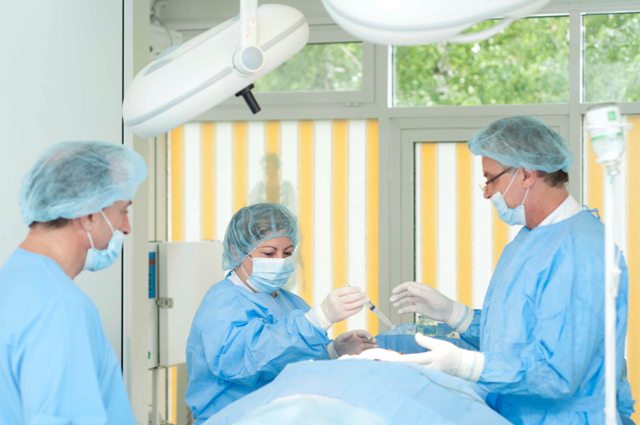

BREAST RECONSTRUCTION
Today, the breast can be reconstructed. The Plastic and Reconstructive Surgery Department of the "SANCOS" Clinic has many surgical solutions that can help you regain the breast you lost. This way you can return to a normal life, fully victorious in the fight against cancer.
The choice of breast reconstruction method is discussed with each patient. The local features of the tissues and the patient's attitude toward one method or another are taken into account.
Innovative reconstructive surgery methods can create breasts that are as similar as possible in shape and appearance to healthy ones.
The female breast can be reconstructed by various methods:
Reconstruction with your own tissue using musculocutaneous flaps (TRAM flap, DIEP flap, a latissimus dorsi flap, a gluteal flap);Breast implants (silicone or saline);
A combination of the two methods.
Breast reconstruction with an implant is done when the breast is removed but the pectoral muscle is kept. In the first stage, an expander is placed: a special empty silicone bag implanted in the chest muscle. After the operation, small amounts of saline are injected through a special device over 2-3 months. The expander gradually enlarges, stretching the muscle and the skin above it. Then the second stage of the operation follows: the expander is removed and a breast prosthesis is implanted in the space created.
Breast reconstruction with the patient's own tissueIf the breast was removed together with the pectoral muscle, or if the skin has hardened (fibrosis) after radiation therapy, surgery using the patient's own tissue is recommended. If the patient's breast is small, a thoracodorsal flap is used. First the musculocutaneous flap is detached from the back, then moved to the chest wall.
The TRAM flap (transverse rectus abdominis muscle flap) is one of the best-known achievements of modern plastic surgery and is considered the best breast reconstruction method. The skin of the lower front abdominal wall is ideally suited in color and consistency for restoring the breast. The flap provides enough tissue volume and skin surface with minimal damage to the donor area.
This method of breast reconstruction is more complicated than skin expansion. On the other hand, when the breasts are fully restored with the patient's own tissue, they look natural.


PROPHYLACTIC MASTECTOMY
Prophylactic mastectomy is a surgical option for people at high risk of breast cancer.
Prophylactic mastectomy is known to reduce the risk of breast cancer by 90-95% in high-risk patients.
The selection criteria for patients for prophylactic mastectomy are:
- Positive BRCA1 and BRCA2 genetic tests;
- A strong family history of breast cancer;
- Breast cancer in one breast;
- Chest radiotherapy before the age of 30;
- Mastopathy that has not responded to conservative treatment or to repeated sectoral resections;
- High breast density or breasts with diffuse microcalcifications.
The decision for a prophylactic mastectomy with simultaneous breast reconstruction can only be made by the breast surgeon and the plastic surgeon after a thorough examination of the patient's risk factors, and in full agreement with her.
The prophylactic mastectomy operation
Prophylactic mastectomy is done under general anesthesia. The approach is chosen individually in each case, depending on the presence and location of scars from previous sectoral breast resections. This operation does not affect lymph drainage from the armpit, so there is no lymph stasis in the arm and recovery is faster. The breast is most often reconstructed with breast implants.
If cancer has affected one breast and the other appears healthy, a contralateral prophylactic mastectomy (on the breast currently without cancer) can also be done.
The breast can be reconstructed in the same operation as the prophylactic mastectomy.


