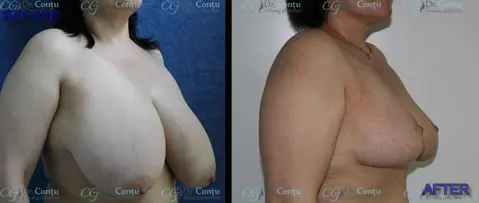
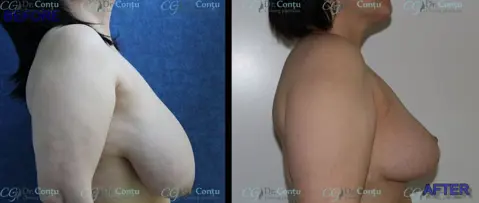
Excessively large breasts can cause severe neck and back pain, repeated irritation in the fold under the breast and, not least, the less attractive look of sagging breasts. This can be corrected with a standard surgical procedure, with the degree of reduction set according to the patient's needs and wishes.
The breast reduction procedure
- The size of the breasts is adjusted by removing fat tissue, glandular tissue and skin; the operation is done under general anesthesia.
- After the incision, the nipple is repositioned, the areola is reduced by excising excess skin if needed, and the inner tissue is reshaped and resized. The incision is then closed with sutures in layers, dressings are applied to the skin, and the breasts are wrapped in an elastic bandage to keep their shape. Suction drains are also needed to prevent fluid from collecting.
Requirements for the procedure
- The ideal candidates for this type of operation are adult women with fully developed breasts.
- The initial discussion with the surgeon is vital in determining the optimal volume, in harmony with the patient's build.
- Both the technique used and the shape of the incision are decided individually by the surgeon, depending on the anatomy of the breasts, the degree of reduction and the patient's physical condition.
Recovery after surgery
- The drains are removed 2-3 days after surgery, and the stitches 12-14 days after the operation.
- Wearing a special bra for a month is recommended.
- After the healing period, regular checkups at 1, 3 and 6 months and at one year are needed.