Breast cancer is a serious disease that, unfortunately, we see more and more often, affecting a growing number of young women. Although it is a malignant disease, it is one of the cancers that can be cured if found and treated early.
Mastectomy (surgical removal of the breast) is the life-saving solution. On the other hand, mastectomy is a mutilating operation.
Today, the breast can be reconstructed. The Plastic and Reconstructive Surgery Department of the "SANCOS" Clinic has many surgical solutions that can help you regain the breast you lost. This way you can return to a normal life, fully victorious in the fight against cancer.
When planning breast reconstruction, the surgeon follows oncological principles, under which the rationale, timing and methods of reconstructive plastic surgery depend strictly on the type and spread of the tumor and on the planned specialized treatment. The choice of reconstruction method is discussed with each patient. The advantages and disadvantages of each method are explained. The local features of the tissues and the patient's attitude toward one method or another are taken into account.
Innovative reconstructive surgery methods can create breasts that are as similar as possible in shape and appearance to healthy ones.
Planning the operation
Planning the breast reconstruction can start as soon as breast cancer is diagnosed. The surgeon will examine you and choose the optimal reconstructive method based on your health, anatomy, age and goals. The ideal solution is for the oncologist and the plastic surgeon to work together.
Reconstruction methods
The female breast can be reconstructed by various methods:
- Reconstruction with your own tissue using musculocutaneous flaps (TRAM flap, DIEP flap, a latissimus dorsi flap, a gluteal flap);
- Breast implants (silicone or saline);
- A combination of the two methods.
Reconstruction with an implant
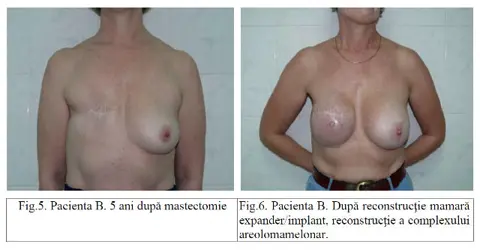
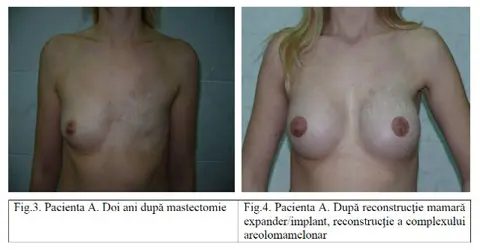
Breast reconstruction with an implant is done when the breast is removed but the pectoral muscle is kept. In the first stage, an expander is placed: a special empty silicone bag implanted in the chest muscle. After the operation, small amounts of saline are injected through a special device over 2-3 months. The expander gradually enlarges, stretching the muscle and the skin above it. Then the second stage of the operation follows: the expander is removed and a breast prosthesis is implanted in the space created.
Breast reconstruction with the patient's own tissue
If the breast was removed together with the pectoral muscle, or if the skin has hardened (fibrosis) after radiation therapy, surgery using the patient's own tissue is recommended. If the patient's breast is small, a thoracodorsal flap is used. First the musculocutaneous flap is detached from the back, then moved to the chest wall.
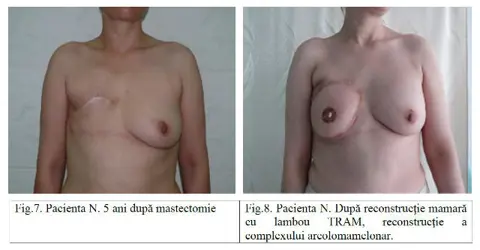
The TRAM flap (transverse rectus abdominis muscle flap) is one of the best-known achievements of modern plastic surgery and is considered the best breast reconstruction method. The skin of the lower front abdominal wall is ideally suited in color and consistency for restoring the breast. The flap provides enough tissue volume and skin surface with minimal damage to the donor area.
This method of breast reconstruction is more complicated than skin expansion. On the other hand, when the breasts are fully restored with the patient's own tissue, they look natural.
Features of the operation
- Visible scars will always remain on the reconstructed breasts, as well as on the donor area (when the free flap transfer method is used);
- Perfect symmetry is impossible, so an additional operation on the healthy breast is recommended afterwards to make the shapes symmetrical;
- The operation does not affect the likelihood of developing breast cancer;
- Medical examinations are usually not made more difficult;
- The operation improves your appearance and, importantly, helps you get rid of psychological discomfort.
Breast reconstruction ends with reconstruction of the nipple and a cosmetic tattoo of the areola.