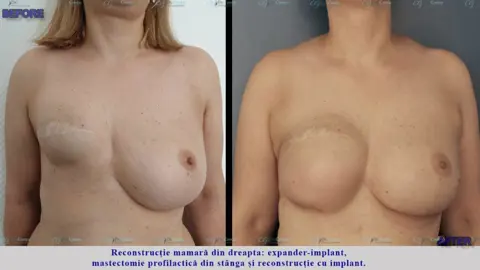
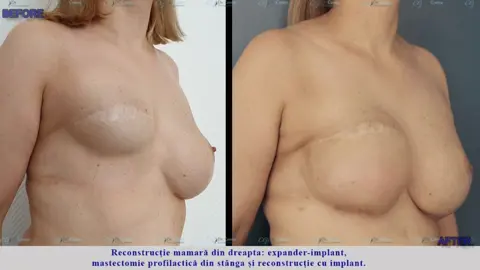
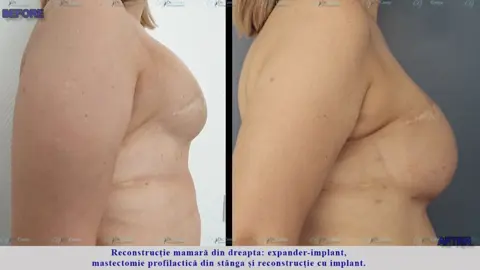
Today we cannot know for certain which patients at risk of breast cancer, with precancerous breast conditions, will develop the disease!
Prophylactic mastectomy is a surgical option for people at high risk of breast cancer.
Prophylactic mastectomy is known to reduce the risk of breast cancer by 90-95% in high-risk patients. However, prophylactic mastectomy does not remove all of the glandular tissue and does not guarantee 100% that the disease will not develop during one's lifetime.
The decision for a prophylactic mastectomy with simultaneous breast reconstruction can only be made by the breast surgeon and the plastic surgeon after a thorough examination of the patient's risk factors, and in full agreement with her.
Patient selection criteria
- Positive BRCA1 and BRCA2 genetic tests;
- A strong family history of breast cancer;
- Breast cancer in one breast;
- Chest radiotherapy before the age of 30;
- Mastopathy that has not responded to conservative treatment or to repeated sectoral resections;
- High breast density or breasts with diffuse microcalcifications.
The prophylactic mastectomy operation
Prophylactic mastectomy is done under general anesthesia. The approach is chosen individually in each case, depending on the presence and location of scars from previous sectoral breast resections. This operation does not affect lymph drainage from the armpit, so there is no lymph stasis in the arm and recovery is faster. The breast is most often reconstructed with breast implants.
If cancer has affected one breast and the other appears healthy, a contralateral prophylactic mastectomy (on the breast currently without cancer) can also be done. The breast can be reconstructed in the same operation as the prophylactic mastectomy. The operation carries risks of anesthesia, bleeding, infection, asymmetry, anxiety and others.
Alternative methods
No conservative treatment prevents breast cancer or stops precancerous conditions from turning into cancer!
There are the following alternative options for preventing breast cancer in high-risk patients:
- Estrogen-blocking medication (tamoxifen, raloxifene) can reduce the risk by about 50%;
- Surgical removal of the ovaries lowers estrogen levels and the risk of breast cancer by 50%;
- A healthy lifestyle, body weight, diet, not smoking, etc. can play some role in preventing breast cancer.
Only prophylactic mastectomy can prevent breast cancer at a level of 90-95%!